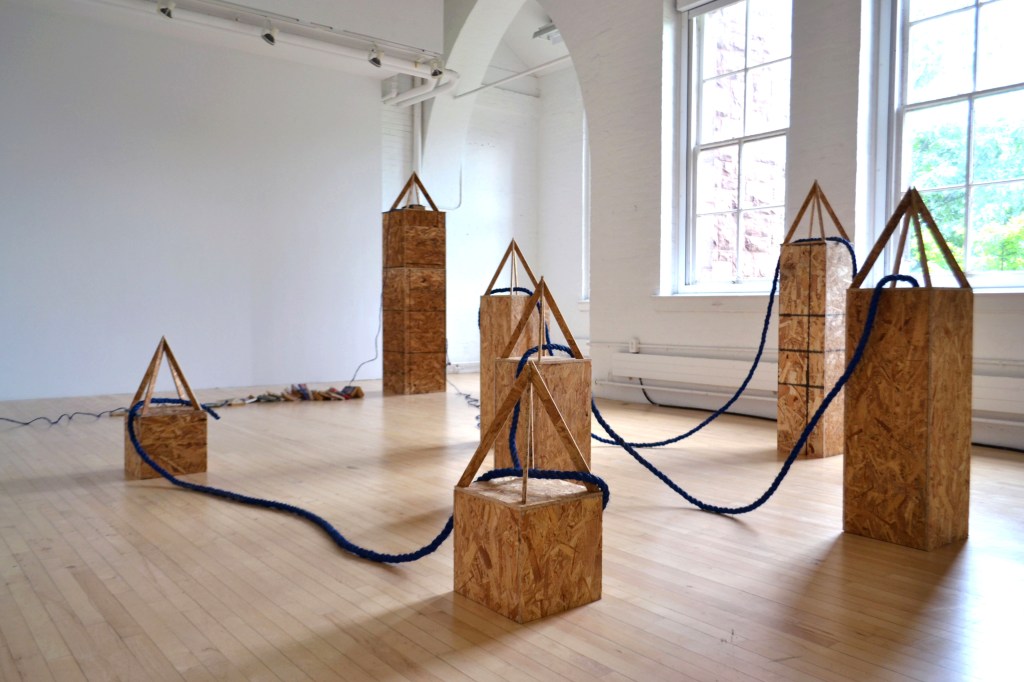


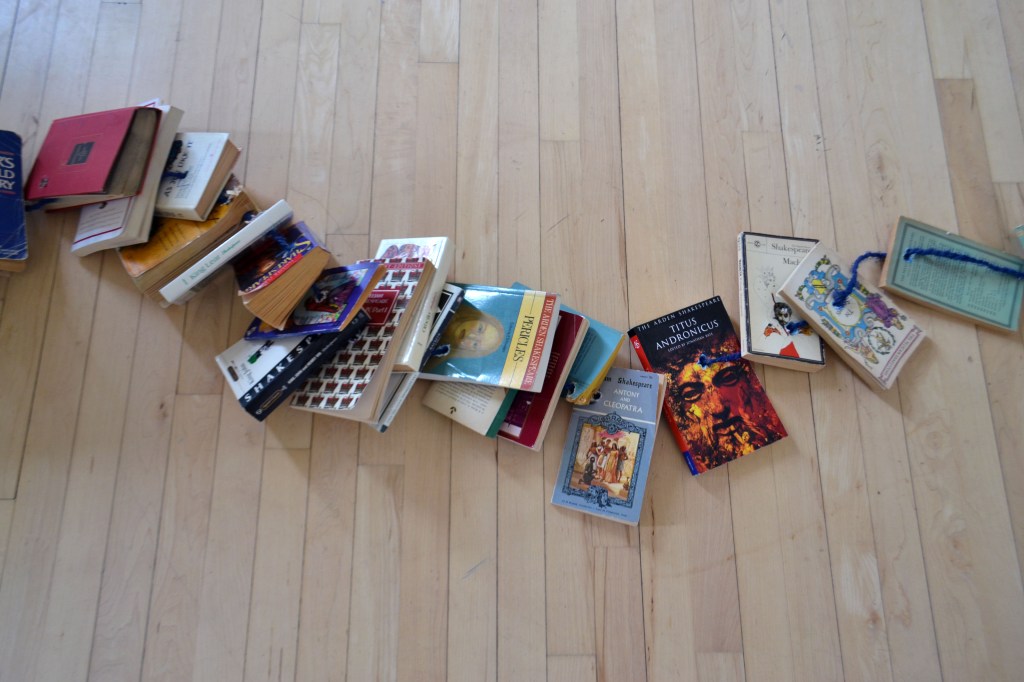
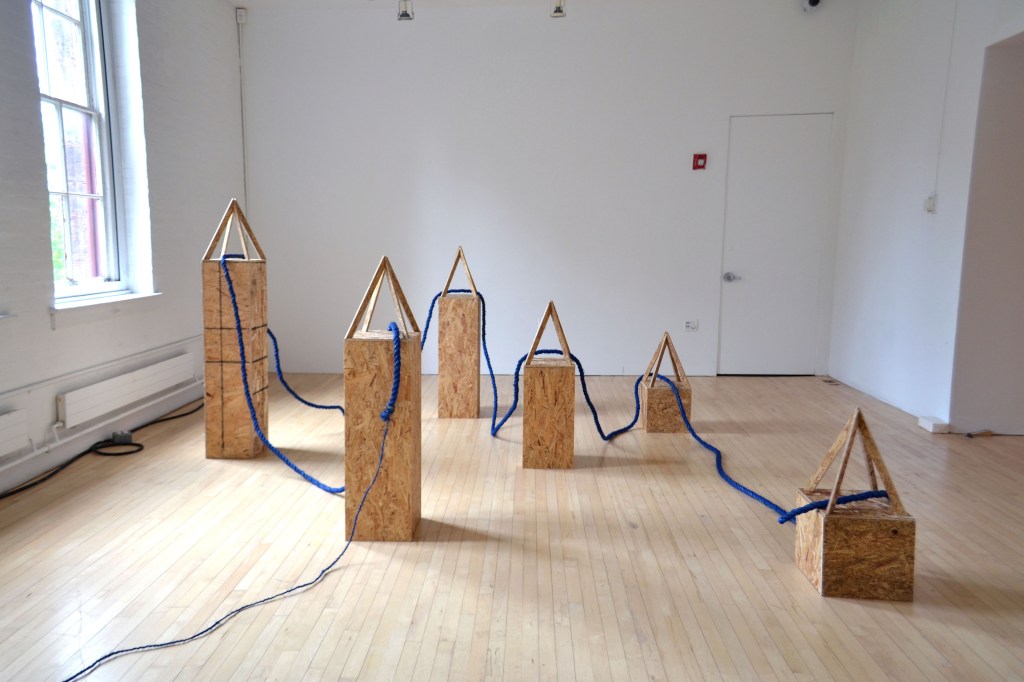
The title of the show and the sculptural installation itself is a quote from Karl Marx but had found the quote before the first chapter of Edward Said’s Orientalism. I felt it appropriate from what I was working with and thinking about: the notion of a monolith, American/western identity and its relationship to place, and the geographical comparisons with shared/repeated historic events of specific places. I am referencing the ancient Egyptian obelisk that is currently erected in New York City’s Central Park, known as Cleopatra’s Needle, and was interested to learn more about. I discovered that during the time when the United States transported the obelisk from Alexandria, Egypt in the late 1800s to install in it in Central Park, a time capsule was buried beneath the obelisk. Inside the time capsule consisted of a Webster dictionary, a bible, the writings of Shakespeare, the 1870 census, and a copy of the declaration of independence. I was intrigued and baffled at the same time because these are all accessible items that can be found today but also are still part of the dominant culture that makes it powerful too. In the work, I incorporated some of the materials which include Shakespeare’s writings and the dictionary that are drilled and tethered to the rope except for the Bible which is sitting and tangled around by the rope and on top of the huge obelisk. The group of medium and small obelisks is intentionally laid out as a map references my home region of Southern Illinois which bears the name known as “Little Egypt” with each obelisk symbolizing as a marker of cities that adopted the same names of cities found in Egypt and Sudan (Cairo, Thebes, Karnak, and Dongola) as well as some countries in the Levantine Arab region (Lebanon and Palestine). The reason it has this name is because the land of Southern Illinois had these resembled similarities of historical events, geography, and even climate that Egypt possessed. The rope throughout the installation represents the Mississippi, the Ohio, and the Nile rivers connecting as one, gathering the global and the local histories together.
